
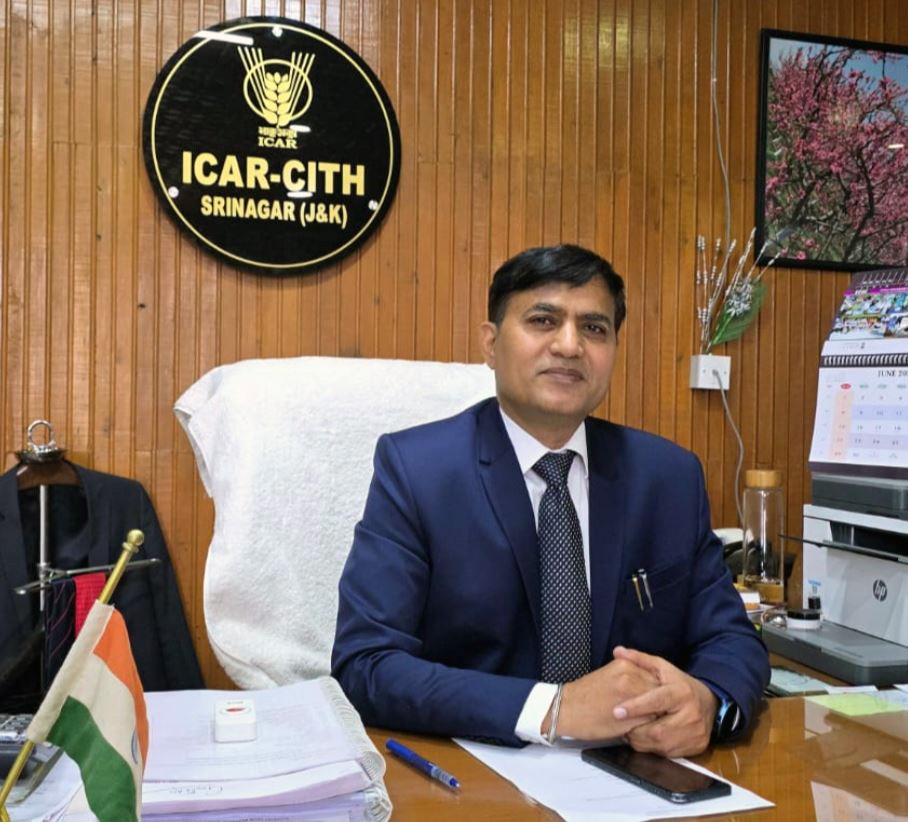
Dr. M K Verma
(Director)
ICAR-CITH
Message From Director
Dear Visitors,
The ICAR–Central Institute of Temperate Horticulture (CITH) is mandated to strengthen research, technology development, and capacity building for sustainable temperate horticulture in the Himalayan and hill regions of the country. The Institute is committed to addressing region-specific challenges related to climate variability, productivity enhancement, quality planting material, pest and disease management, and value chain strengthening of temperate fruit and vegetable crops.
In recent years, the Institute has made significant contributions through the release of seven improved crop varieties, including apple, walnut, onion, and garlic, and through the development of high-density apple production technology and intensive saffron cultivation technology, both of which have been adopted under national missions. The Institute has also provided critical technical inputs for the formulation of the horticulture development roadmap for Jammu & Kashmir, contributing to evidence-based planning and policy support.
Aligned with India’s Vision 2047, ICAR–CITH is strategically orienting its research and extension programmes towards enhancing farmers’ income, ensuring food and nutritional security, and building climate-resilient horticultural systems. The Institute’s interventions directly contribute to the Sustainable Development Goals, particularly SDG 2 (Zero Hunger) through productivity enhancement and diversification, and SDG 13 (Climate Action) through promotion of climate-smart technologies, high-density systems, and resource-efficient production practices.
ICAR–CITH continues to promote improved varieties, elite rootstocks, scientific orchard management practices, integrated pest and disease management, and post-harvest and value-addition technologies, leading to improved productivity, quality, and market returns. Large-scale dissemination of high-density apple production systems and strengthening of institutional nursery infrastructure have supported orchard rejuvenation and reduced dependence on imported planting material in the region.
The Institute operates through its headquarters at Srinagar and Regional Stations at Mukteshwar (Uttarakhand) and Dirang (Arunachal Pradesh), enabling effective research, validation, and dissemination of location-specific technologies across diverse temperate and high-altitude agro-ecologies. Through focused farmer trainings, technology commercialization, and inclusive development programmes such as SCSP and TSP, the Institute remains committed to sustainable growth and livelihood enhancement in temperate horticulture.
Warm regards,
Director
ICAR–Central Institute of Temperate Horticulture
Srinagar, J&K